
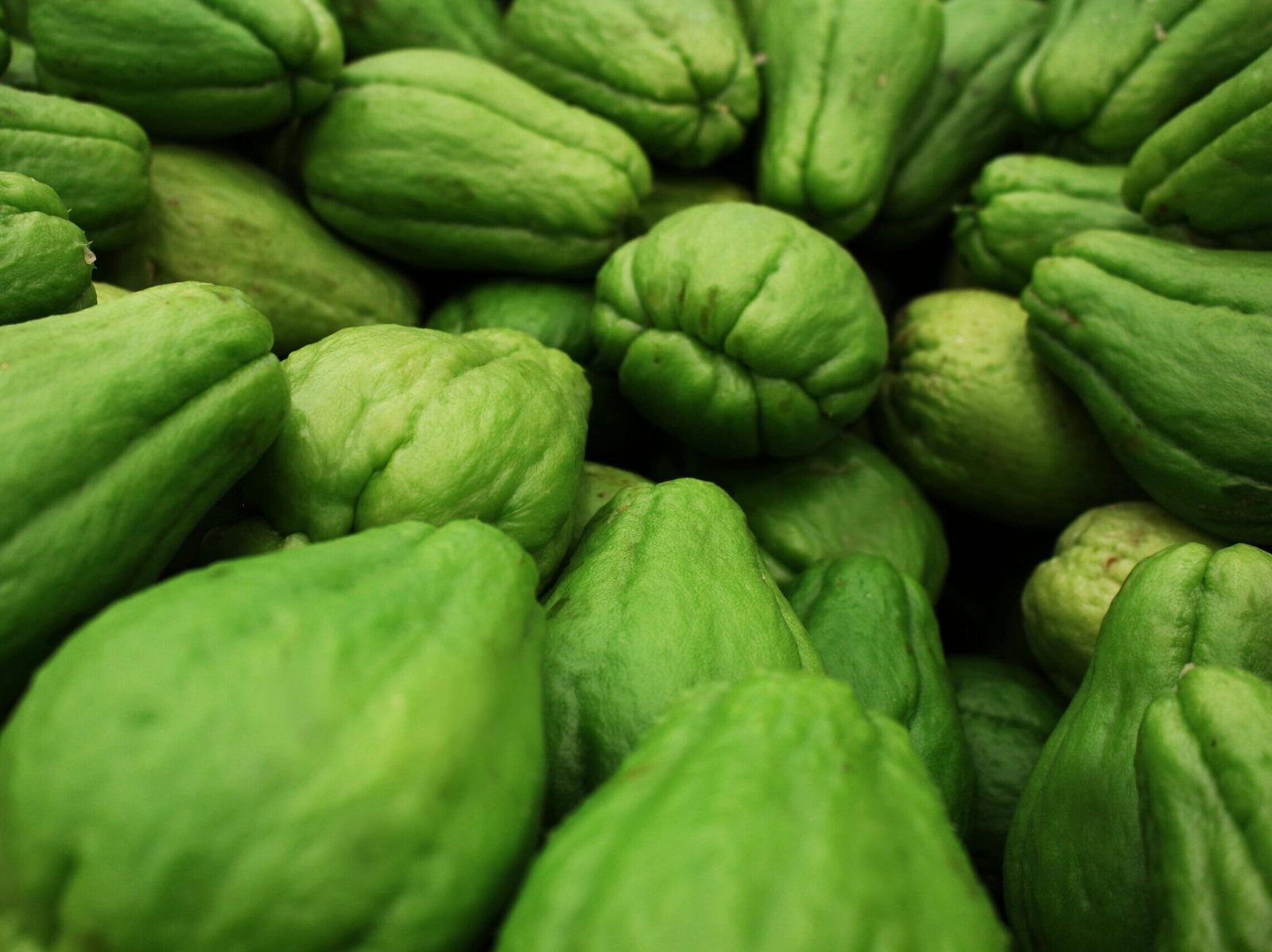
Those nutrient-rich, pear-shaped cucurbits – which means that, botanically, they are a fruit, inasmuch as they develop from a flower’s ovary and contain seeds – is, generally, enjoyed raw or used in cooking as a vegetable. They originated in southern Mexico and Guatemala, being cultivated by the Aztecs, Mayans and other indigenous folks for centuries before being spread globally by Spanish explorers in the 16th century.
“With its somewhat wrinkled, puckered bottom, it might bring a spontaneous smile to your face. And no, its first name and middle initial is not Wile E. as in the Roadrunner’s nemesis!”
Some other folks call it a Custard Marrow, Mango Squash, or Vegetable Pear. In Brazil, it’s called Xuxu, (pronounced chuchu) – also an affectionate name for someone such as “cutie” or “sweetie”… or what we called the early morning, “milk run,” steam-powered locomotives of my youth out in western Kansas!
(How easily I get diverted from the primary topic at hand!) And in New Orleans, there is even a festival celebrating it, where those folks call it mirliton.
The entire plant has uses with its fruit (similar in flavor to a mild mix of cucumber and zucchini), leaves, shoots, and even the root tubers, which are edible, with a taste like potatoes. Not wanting to be left out, its durable vines are employed to weave hats and baskets!
Chayote is a good source of dietary fiber, minerals, protein, vitamins, and other nutrients. One-half cup of it has 17 percent of the daily requirement for Vitamin C. It includes flavonoids, folic acid, and potassium. Additionally, its seeds are a rich source of several amino acids. Low in sodium, it contains only two to four milligrams of sodium per squash and has anti-cancer, anti-diabetic, anti-inflammatory, and anti-obesity properties.
In fact, according to Health.com: “Chayote’s antioxidants may prevent cell damage and boost longevity… (its) fiber promotes heart and gut health by lowering cholesterol, helps with digestion, lowering blood pressure, and improving blood sugar levels.” Pretty good stuff for a lime-green colored, crinkly-bottomed, semi-flattened, pear-shaped vegetable/fruit!
What follows – from the soon-to-be-published second volume of my new book series The Edible Jungle – is this easy-to-prepare, delicious, and very healthful salad recipe. (By the way, all six volumes of The Civilized Jungle and The Medicinal Jungle, as well as volume I of The Edible Jungle may be acquired via Amazon Books. . . . or come on down to Manzanillo for a personally inscribed copy following the daily Ola Brisa Garden tour [Check us out on TripAdvisor] that I give. They are by reservation only, Monday through Saturday, consisting of groups from six to twelve, commencing at 9:00 or 9:30 AM – cost $20 per person.
Chayote and Mexican Corn Salad (Serves Six)
“Inspired by Mexican Street Corn, the acidic tang of the Lime juice, salty crumbly cheese, and kick of the Chili flakes highlight this dish.”
Ingredients:
One (1) nicely sized Chayote
Two (2) Tablespoons Olive Oil
The kernels from four (4) ears of Corn
Four (4) tablespoons Japanese mayonnaise
One-half (1/2) cup of feta cheese, crumbled
Three (3) Scallions (roots removed) thinly sliced
One (1) sprig of Cilantro, chopped with no stems
Three (3) sprigs of Mint, chopped
One (1) large Garlic clove, grated
Juice from one (1) fresh Lime
A pinch of salt
Instructions:
• Heat oil in a skillet until it shimmers; add Chayote and a pinch of salt, cooking over high heat until softened and slightly charred; transfer to a large bowl
• Add remaining Tablespoon of oil to the now-empty skillet (still on high heat); when hot, add Corn; season with salt and cook until charred on one side (Please don’t ask me which side?); at this point, stir and cook until both sides are slightly charred; transfer to bowl with Chayote
• Add the mayonnaise, cheese, Chili flakes, Cilantro, Garlic, Lime juice, Mint, and Scallions; toss to combine
• Adjust seasoning with additional salt and Chili flakes, to taste.

